In our previous analysis, we explored the global landscape of perfumes and cosmetics and highlighted the most relevant regional shifts shaping consumer behaviour. Building on that foundation, this article has a closer look at Latin American Perfume Market – a region where fragrance holds a unique cultural position and where several emerging trends are reshaping consumer behaviour, product development, and retail execution.
To understand these changes, it is essential to examine not only what is happening across LATAM’s fragrance market, but also why these dynamics are accelerating now. With operational presence in Brazil, Paraguay, and Uruguay, and deep category experience across travel retail and domestic channels, Weitnauer Group has first-hand visibility into how these developments translate into commercial opportunities for brands.
LATAM Perfume Market Size and Momentum: A Region Defined by Fragrance
According to McKinsey Study, Latin America is among the fastest-growing global beauty regions, expected to expand around 7% annually through 2028, slightly above worldwide growth rates (6%).
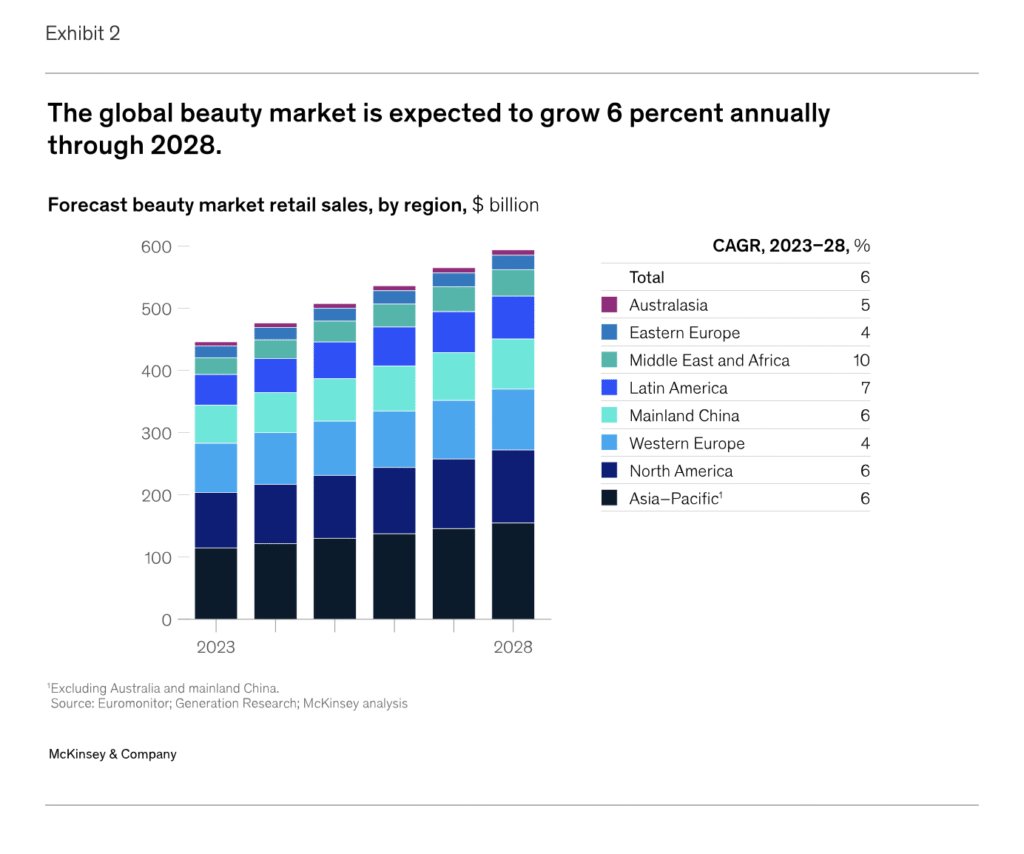
Within this upward trend, fragrance stands out as the region’s strongest engine, consistently outperforming makeup, skincare, and haircare in both penetration and value performance. Several indicators highlight the scale and resilience of this category:
- Fragrance represents roughly 65% of total beauty sales in LATAM – an extraordinary share compared with other regions.
- Latin America recorded 0.09 billion perfume units consumed in 2025, driven by Brazil (0.04 billion), Argentina (0.03 billion), and Chile (0.02 billion).
- Brazil is leading the region’s fragrance growth, with the market valued at USD 2.08 billion in 2024 and projected to reach USD 3.22 billion by 2033.
This sustained momentum reinforces LATAM’s position as a fragrance powerhouse, where scent is not an accessory but a core element of identity, lifestyle, and self-expression.
Cultural Foundations: Why Fragrance Dominates LATAM Beauty
Latin America’s affinity for perfume is not a trend – it is a cultural constant.
Consumers across the region show:
- High daily usage frequency. For instance, on average, Brazilians consume around 186 ml of perfume per year, which is equivalent to 2.5 bottles of perfume.
- Strong emotional attachment to long-lasting scents. Preference for expressive, intense, and signature-driven profiles. Euromonitor reports that Brazilians prioritize price and fragrance profile over brand name when selecting a perfume.
This behavioural pattern is amplified by:
- A growing middle class
- Youthful demographics
- A strong tradition of fragrance gifting
- Expanding hybrid retail environments (store + online + cross-border)
As retail access broadens, exposure to Middle Eastern, niche, and artisanal fragrance houses accelerates, reshaping expectations around longevity, concentration, and identity-driven scents.
Brazil’s Central Role: Scale, Production Power, and Strategic Influence
Brazil is the region’s flagship fragrance market – and a global benchmark in its own right.
The country combines:
- A large, fragrance-savvy population
- High per-capita usage
- A well-developed domestic manufacturing ecosystem
- Rapid expansion of premium, niche, and high-concentration formats
Brazil leads LATAM in both value and volume, and its influence extends far beyond finished perfume. The broader flavors and fragrances market reached approximately USD 1.21 million in 2024, with projections close to USD 2.28 million by 2033 – signaling strong growth in aroma chemicals and natural extracts (Grand View Research, 2025).
For international brands, this positions Brazil not only as a demand driver but also as a strategic production and innovation hub.
Intra-Regional Differences: One Region, Several Consumption Models
Despite cultural familiarity with scent, Latin America is not homogeneous. Understanding country-level nuances is essential for portfolio planning, pricing, and distribution strategy.
- Brazil
Mass-oriented, but premium and luxury segments are gaining momentum (Bonafide Research, 2025) - Mexico
Strong affinity for prestige and niche brands, heavily influenced by social media, creator reviews, and e-commerce (Playbook of Beauty, 2025). - Argentina
Argentina’s fragrance market is evolving fast, with consumers moving toward niche creations and more sustainable choices. Mass fragrances remain the largest segment, but niche scents are accelerating as the strongest growth driver (Market Research Future, 2025). - Colombia & Chile
Growing demand for premium offerings, supported by rising urbanisation and personal care spending (Mordor Intelligence, 2025). - Paraguay & Uruguay
Lower category saturation but high fragrance interest and steady premiumisation — ideal gateways for brand expansion. A rising shift toward gender-neutral fragrances is reshaping the market, mirroring broader social changes in how consumers view identity and self-expression (Open PR, 2025) .
Collectively, these differences create a multi-speed market, requiring precise assortment planning and strategic channel selection.
Drivers of LATAM Fragrance Demand
Rising Middle-Income Groups
Urbanisation and income growth expand access to mid-tier and premium scents, particularly in Brazil, Paraguay, and Mexico.
Premiumisation and Higher Concentrations
Consumers increasingly favour extrait de parfum, oils, and long-lasting profiles — formats perfectly aligned with regional preferences.
Digital Discovery and Social Influence
TikTok, Instagram, and YouTube drive real-time trend adoption. Viral content fuels interest in niche notes, Arabic perfumery, and indie houses.
E-Commerce and Cross-Border Commerce
LATAM shows some of the strongest global e-commerce growth, supported by improved logistics and mobile-first purchasing behaviour (McKinsey, 2024).
Paraguay’s role as a regional shopping hub continues to accelerate accessible premium consumption.
The Rise of Arabic and Oriental-Inspired Fragrances
One of the most defining shifts across the region is the adoption of Arabic and oriental fragrance houses.
Why the rapid rise?
- Signature-heavy scent DNA
Oud, amber, musk, and oil-based formats match LATAM’s preference for intensity and longevity. - Social media virality
Brazilian creators compare Arabic lines with Western luxury brands, boosting awareness. - Retail expansion
Specialised stores and cross-border retailers increasingly stock Middle Eastern lines. - Identity and craftsmanship
Younger consumers value storytelling, heritage, and artisanal quality.
With distribution operations in Brazil, Paraguay, and Uruguay, Weitnauer is ideally positioned to support the introduction and scale-up of these brands across the region’s retail and travel retail networks.
Four Challenges Brands Must Navigate when Entering Latin America
While opportunities are strong, successful entry requires navigating regional complexity.
1. Regulatory Variation
Each country has its own compliance requirements, making local expertise essential.
2. Import Duties and Pricing
High tariffs — particularly in Brazil — demand thoughtful margin architecture.
3. Counterfeiting and Informal Trade
Controlled, transparent distribution is critical to protect brand equity.
4. Climate and Logistics
High temperatures and humidity require climate-sensitive logistics.
Weitnauer’s established infrastructure ensures consistent product stability across long distances and variable conditions.
Where the Market’s Strongest Opportunities Lie
Underdeveloped Markets Outside Brazil
Paraguay and Uruguay have strong interest but lower saturation — ideal for expansion.
Personalisation and Bespoke Experiences
AI scent profiling, discovery kits, blending bars, and custom packaging resonate strongly with LATAM consumers.
Travel Retail as a Visibility Booster
Airports in Brazil and Uruguay offer high-impact touchpoints.
Weitnauer’s travel retail presence ensures brands benefit from consistent visibility across regional traffic flows.
Outlook for 2025 and Beyond
The perfume market in the Americas is expected to grow at a CAGR of 5.9 percent through 2032, propelled by premiumisation, rising middle-income groups, personalised formats, and the expanding influence of Arabic fragrances.
Brands that combine strong product identity with regional insight, flexible go-to-market models, and strategic distribution partnerships — such as those offered by Weitnauer Group — will be best positioned to capture growth in this diverse and rapidly evolving region.